
Understanding Movement. Measuring Consistency. Advancing Athlete Development.
Behind every repetition is a movement pattern. Behind every movement pattern is data that can help us better understand how an athlete performs.
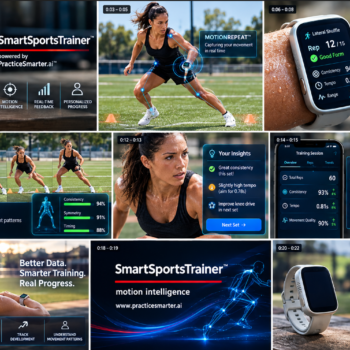
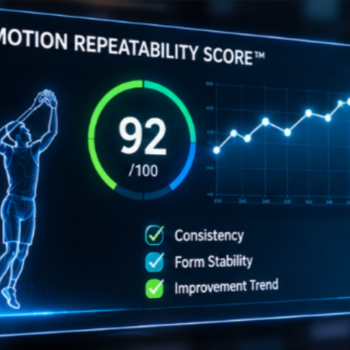
The PracticeSmarter.ai™ combines wearable motion sensing, movement analysis, personalized baselines, and intelligent algorithms to evaluate movement repeatability and help athletes better understand their training.
Movement Is More Than Repetition.
Two athletes can perform the same exercise, complete the same number of repetitions, and produce very different movement patterns because every athlete has a Unique Movement Pattern.
A movement fingerprint represents an athlete’s characteristic movement pattern for a particular activity or drill. Even the same athlete can perform a movement differently from one repetition to the next.
Our technology is designed around an important concept: understanding how consistently an athlete repeats a movement over time.
Rather than focusing exclusively on activity volume, we focus on movement patterns, repeatability, and changes relative to an athlete’s personalized baseline.
The Outcome Is Visible. The Movement Behind It Matters.
A missed shot, inconsistent golf swing, or poorly executed tennis stroke is an observable outcome. Understanding the movement patterns behind those outcomes can give athletes and coaches additional information to guide training.
Movement Fingerprints
A movement fingerprint represents an athlete’s characteristic movement pattern for a particular activity or drill. By establishing a personalized reference, the technology can compare subsequent repetitions against that athlete’s own movement characteristics.
This is important because athlete development should not rely exclusively on comparing one athlete to another. The focus is on understanding an athlete’s movement relative to their own established baseline.
From Science to Practice
PracticeSmarter.ai isn’t trying to make athletes move like robots but making movement intelligence accessible. It’s working to help them understand, measure, and improve how consistently they reproduce the movements that matter. The science becomes valuable when athletes and coaches can use the information.
The following published research provides scientific context for the principles behind movement repeatability and the development of MOTIONREPEAT™
Fatigue-Related Reductions:
This research examined movement smoothness during athletic movement tasks and investigated how fatigue can influence the coordination and execution of those movements.
Muscle Fatigue:
This study examined how static and dynamic fatigue affected muscle coordination strategies. The researchers found changes in muscle synergy contributions while also observing that the nervous system could preserve aspects of movement.
Learning a specific, individual skill:
Researchers tracked upper-body and arm movement Their findings indicated that inter-joint coordination changed during fatigue, with participants adopting a different movement strategy.
Motor Learning and Movement Variability:
Work in motor control is associated with the concept often described as “repetition without repetition.” Skilled movement involves adapting the coordination of the body across attempts rather than reproducing identical mechanical sequence every time.
Scientific Disclaimer:
The research listed above provides background on human movement, fatigue, biomechanics, motor coordination, and motor learning. These publications do not constitute independent validation of MOTIONREPEAT™, SmartSportsTrainer™, or the Movement Repeatability Score™.
MOTIONREPEAT™ and MRS™ are proprietary technology and measurement concepts under development. Their accuracy, reliability, and relationship to sport-specific performance outcomes require appropriate testing and validation.
Our initial focus is on committed, actively training athletes who want more than general workout tracking. They want measurable feedback on their sport-specific movements and a better understanding of their progress.